Why is the cement industry hard to abate?
Cement decarbonisation, one of the hard to abate processes with a major emissions contribution



Cement has the weight of the world on its shoulders in more ways than one. A vital binding agent in construction, used to create concrete.
Essential for building foundations, walls, roads, and bridges, providing structural strength, durability, and fire resistance.
As global construction and infrastructure moves inexorably forward, there is a price to pay - cement production contributes approximately 8% to global CO2 emissions.
Cement Production
Global cement production is around 4.0 to 4.4 billion tonnes annually. Just to get that number in some kind of mental perspective as it completes its product journey to finished concrete - which is the second most consumed material in the world:
💧Water - over 9 billion cubic metres annually
🪨 Concrete - over 4.16 billion cubic metres annually
Globally, most cement is made in Asia, with China producing over 2 billion tonnes, and India and Vietnam ranking next.
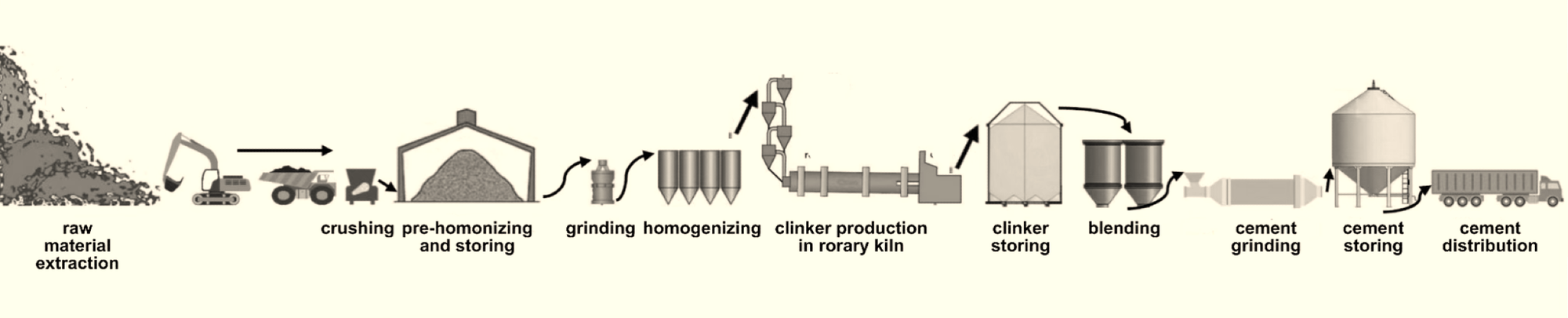
Extensive mining of raw materials, such as limestone (calcium), clay (silica), and iron ore, are required - a process dominated by fossil-fuel powered equipment and supply chains.
After crushing the raw material into small, tennis ball-sized pieces, it is ground into a fine powder and then homogenised.
A fossil-fired kiln heats the raw materials at approximately 1450℃ to create an intermediate product called clinker, which is then cooled and finely ground with gypsum, which regulates the setting time, to make the final cement powder.
The final cement product is stored in silos before packing or distribution via fossil-fuel based logistics chain.
Production Process Emissions
Roughly 40% of the emissions result from burning fossil fuels (coal, gas, or oil) to heat kilns, while the remaining 60% are process emissions from chemically transforming limestone into clinker - coal is the primary fuel.
CO2 emissions from production are largely driven by the chemical process of calcination, where limestone CaCO3 is heated to produce lime CaO.
This chemical reaction releases directly from the raw material, accounting for roughly 65% of emissions, while fossil fuel combustion for heat accounts for the remaining 35%.
CaCO3 + heat → CaO + CO2
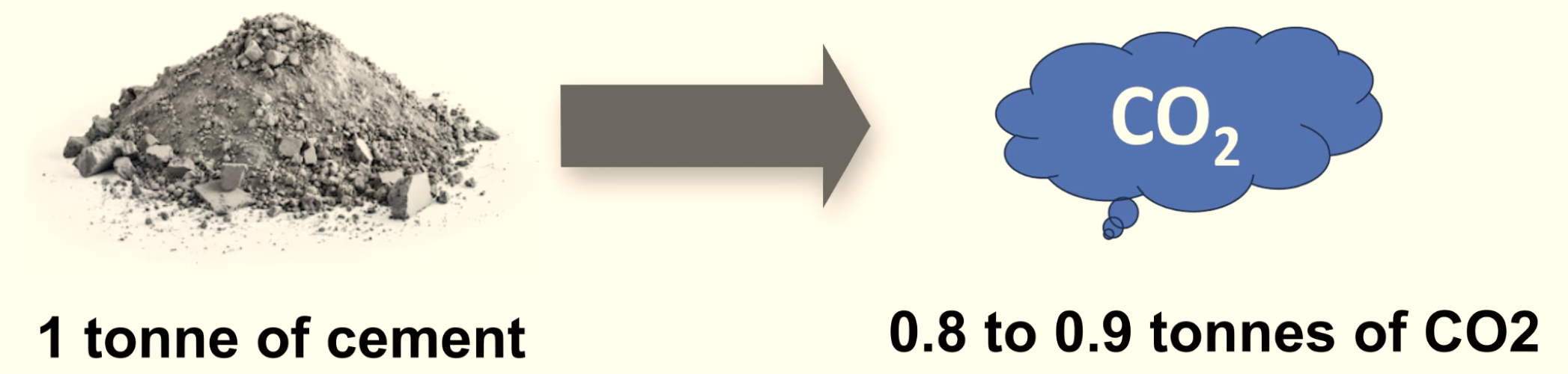
The production of 1 tonne of cement typically generates between 0.8 and 0.9 tonnes CO2, depending on the manufacturing efficiency and the type of cement produced.
A weighty problem.
Cement Decarbonisation Options
Alternative Fuels
Offer an interim solution - waste and biomass currently represent nearly half of all fuels used in the EU cement industry. However, the biomass supply chain is uncertain due to increased competing demand from other sectors of the economy. Conventional power stations often burn wood chips, wood pellets, and agricultural residues to generate electricity or supply district heating. This is currently the largest competing use for biomass.
Electrification of Heat
Using green electricity to provide process heat instead of fossil-fired incumbents could contribute to decarbonisation. However, the price of electric heat is 3-4 times higher than the equivalent heat energy in natural gas, coal or biomass.
Hybrid Solutions
Combining existing combustion technology with electric heating allows plants to operate as "hybrid-electric," lowering capital costs and enabling them to use grid power only when it is cheap - when power generation exceeds grid demand.
Carbon Capture and Storage
CO2 capture is possible to apply to both combustion and process emissions, or by combining a green energy heat source with the capture of chemical process emissions.
As of April 2026, CCS ranges from €50 to €300/tonne of CO2 or €175/tonne of CO2 on average in the EU. The average price of standard Portland cement in the EU currently ranges from €80 to €150/tonne.
CCS has a high cost and significantly increases cement prices. Unless legislation drives this change and markets receive heavy subsidies, it is unlikely to have a significant volume impact - but it will have a significant public cost.
Green Hydrogen for Heat
Energetic vandalism and pure economic nonsense!
Different Pathways
Clinker can be partially replaced with supplementary cementitious materials like fly ash from coal power plants and blast furnace slag from steel production. A reduction in clinker usage means that less process energy is required, helping to avoid some emissions.
However, depending on the decarbonisation strategies of the power and steel industries, these alternative materials may become less accessible in the future.
Alternative chemistry solutions are being developed. Kane recently interviewed one such company, Material Evolution, working on an alkali fusion process with no fossil-combustion, an entirely ambient temperature solution.
 Kane Watkinson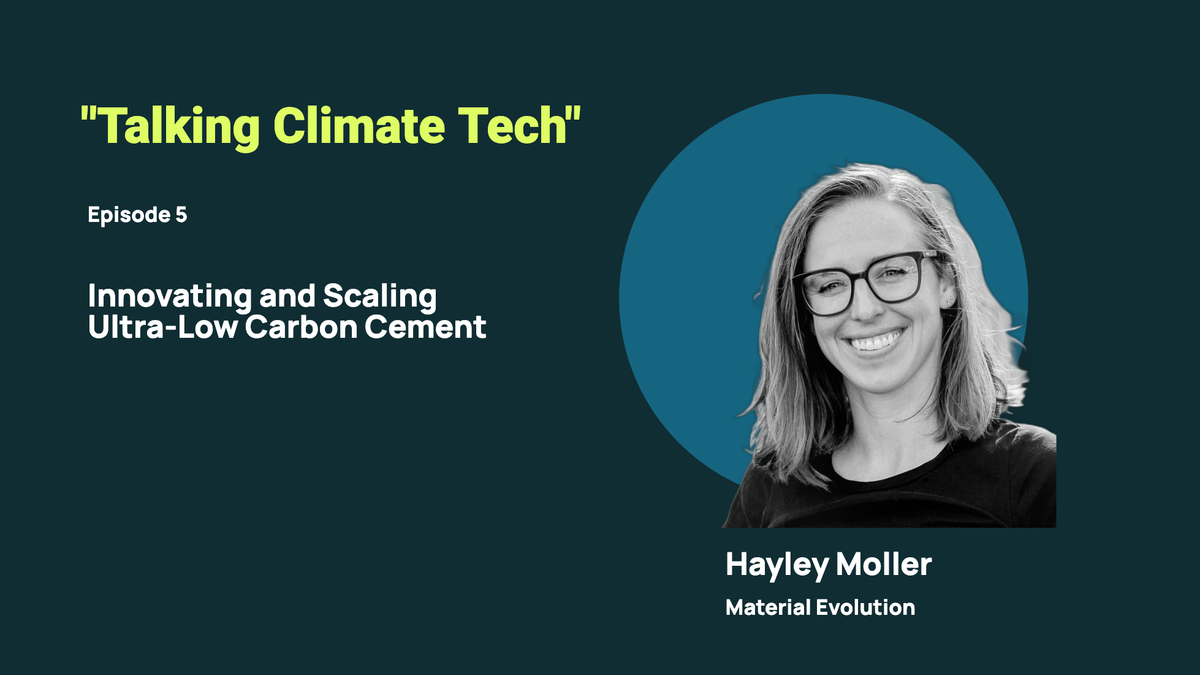
Weighing Up
Achieving deep decarbonisation of cement production is very complex.
Unlike many other industries, a significant portion of cement's CO2 emissions comes from the process itself, occurring when converting limestone (CaCO3) into lime (CaO) in a fossil-fired kiln at 1450℃.
This makes decarbonisation especially difficult, as cutting CO2 emissions is not just about decarbonisation of heat energy, but also about chemistry.
About the Author
Michael Sura

Michael Sura - Energy and transport analyst, strategist, and advisor, based in Slovakia 🇸🇰