Opportunities and challenges for Lithium-sulphur batteries
Lithium-ion batteries are everywhere, scaling exponentially with costs falling just as fast. What about the lesser-known lithium-sulphur solution?



Li-ion battery storage is undoubtedly one of the leading technology developments of the energy transition. It has literally changed the way our energy system works at grid scale, and the way we operate and interact with technology and transport daily.
What could the lesser known lithium-sulphur (Li-S) chemistry offer us by comparison? Could it possibly be the next evolution in battery technology?
Li-S offers a higher energy density, lighter weight, lower material costs, and improved environmental and safety features compared to regular lithium-ion batteries.
Is this the panacea of battery storage mediums we have been looking for?
The basics
Sulphur is an abundant, low-cost industrial byproduct, making the raw materials significantly cheaper than rare metals like cobalt or nickel. It ranks as the 10th most abundant element in the universe, and the 5th most common on Earth.
Because of the lightweight nature of sulphur and lithium, Li-S batteries are much lighter than traditional battery types.
Li-S batteries typically operate at a nominal voltage of 2.1 volts per cell, which is lower than the 3.2V to 3.7V of standard lithium-ion batteries. Li-S batteries can theoretically achieve a specific energy of up to 2600 Wh/kg, which is x3-5 greater than conventional lithium-ion batteries. In real-world applications, they currently provide between 300 Wh/kg and 500Wh/kg.
Safety aspects
Unlike metal-oxide batteries, sulphur cathodes do not decompose and release oxygen that can fuel fires if the battery overheats, which greatly lowers the risk and severity of thermal runaway.
The simplified chemistry involves non-toxic, sustainable materials and has fewer components, which significantly reducing the cost and complexity of the recycling process.
So far so good; the benefits by comparison to Li-ion look significant.
The chemistry
Unlike traditional lithium-ion batteries that rely on intercalation (where lithium ions slide into gaps within an electrode host material), lithium-sulphur batteries operate via a multi-stage chemical conversion reaction.
Metallic lithium at the negative electrode (anode) oxidises to release lithium ions (Li⁺) and electrons. At the positive electrode (cathode), elemental sulphur (S₈) accepts these ions and electrons.
This process reduces the sulphur through a series of intermediate steps, forming soluble lithium polysulphides (Li₂S₈, Li₂S₆, Li₂S₄) before finally converting into solid lithium sulphide (Li₂S₂ and Li₂S).
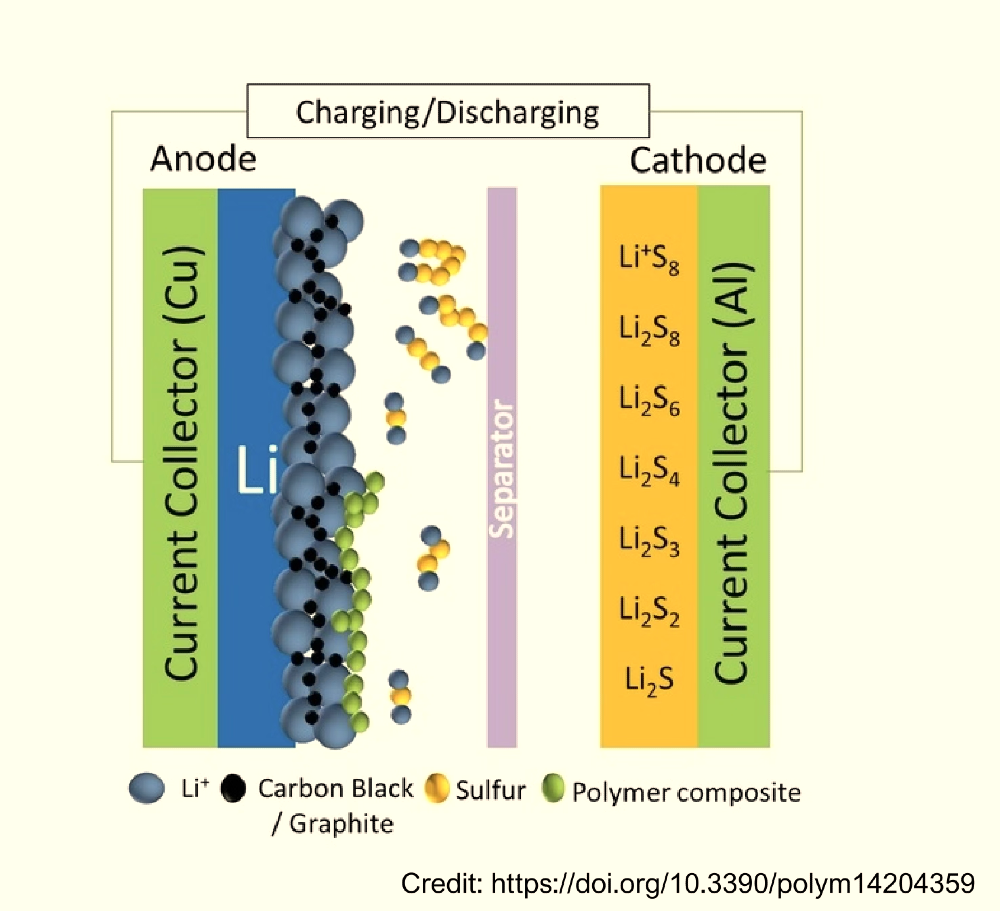
The polysulphide shuttle effect poses a significant chemical challenge in lithium-sulphur (Li-S) batteries.
When the battery operates, sulphur at the cathode interacts with lithium and dissolves into the liquid electrolyte, creating intermediate compounds known as lithium polysulphides (LiPSs). These dissolved polysulphides move through the battery's separator to the lithium metal anode.
At the anode, the polysulphides react with lithium, transforming into low-order polysulphides. These low-order polysulphides then return to the cathode, where they are re-oxidised into high-order polysulphides, restarting the cycle.
This process traps and consumes active sulphur material, which permanently reduces the battery's energy storage capacity.
To mitigate the shuttle effect in Li-S batteries, researchers utilise a combination of physical confinement, chemical trapping, and catalytic conversion. In Lyten's solution, their 3D Graphene:
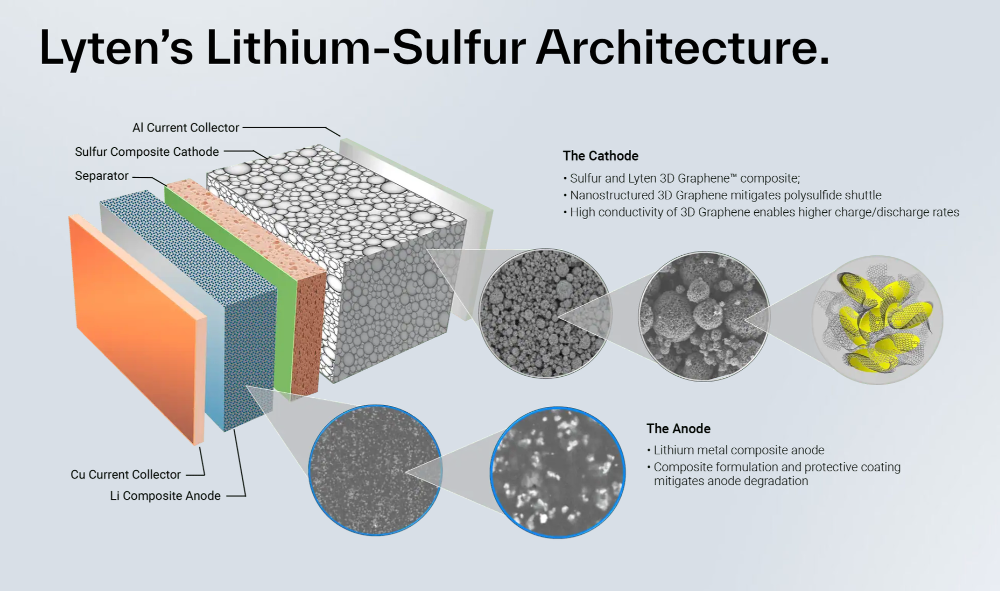
This strategy prevents long-chain lithium polysulphides from dissolving in the electrolyte and migrating to the lithium anode, which can cause rapid capacity loss.
Market watch
Prominent manufacturers and developers of Li-S batteries include companies such as Lyten, Zeta Energy, and Li-S Energy.
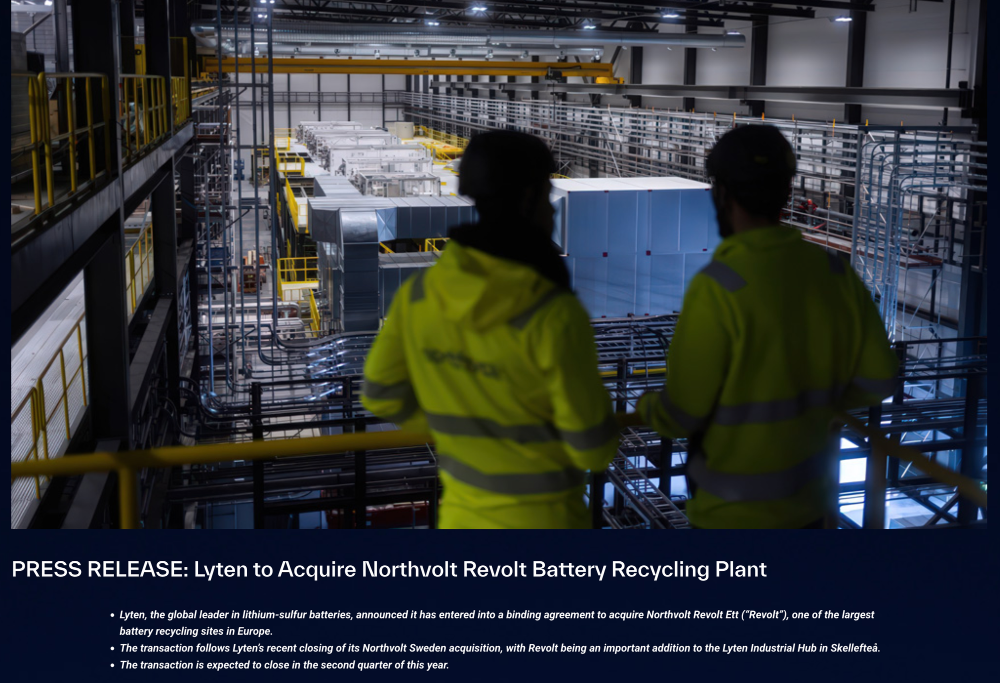
Lyten, based in Silicon Valley, acquired nearly all physical and intellectual property assets from the bankrupt European battery manufacturer Northvolt. More on that acquisition here.
Production
While increasing giga-scale production of its lithium-sulphur batteries, Lyten will temporarily manufacture traditional lithium-ion cells at these facilities.
Once Li-ion facilities are ready to be switched to Li-S, they have an effective process:
Lyten Lithium-Sulfur’s automated pilot line in San Jose, CA was converted from a lithium-ion line for <3% of capital. That pilot line quickly ramped up to >90% yields for both pouch and cylindrical cells.
Commercial challenges
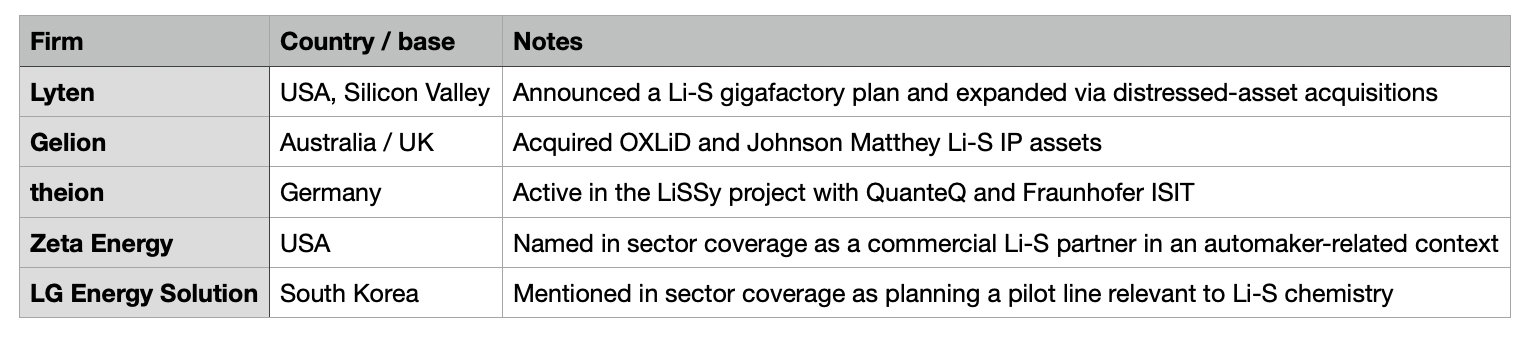
Developing commercial Li-S batteries is highly challenging, leading to several high-profile bankruptcies and corporate collapses. The primary casualties so far, plus those who are still active after some industry consolidation:
Active companies
Inactive companies

Li-S batteries hold the promise of revolutionising energy storage technology, but the battery industry must address the polysulphide shuttle effect to realise this potential.
The potential is there, as is the glory! The question remains: can delivery occur at market scale before the next financial collapse?
About the Author
Michael Sura

Michael Sura - Energy and transport analyst, strategist, and advisor, based in Slovakia 🇸🇰