
Biomass x Sustainable Aviation Fuel - Another Challenging Flight Path
Aviation accounts for roughly 2.5% of global human-induced CO₂ emissions, burning about 300 million tonnes of jet fuel annually. It's another in the 'hard to abate' emissions category.



The aviation sector is one of the 'hard-to-abate sectors' because replacing fossil kerosene proves very difficult, and commercial flights cannot currently use zero-emission alternatives like heavy batteries or hydrogen.
Sustainable aviation fuel (SAF) is a renewable fuel that can directly replace conventional aviation fuel. It can power existing aircraft, and airport infrastructure does not require any modification.
But is it a viable solution?
SAF Raw Materials
The most widely used process for producing renewable SAF is the hydro-treated esters and fatty acids (HEFA) process. HEFA primarily depends on waste oils and animal fats. However, the global availability of these oils and fats is quite limited, relatively speaking, as a source for aviation fuels.
Used cooking oil faces strong competition from other biofuel sectors. This limitation significantly hinders the long-term growth of SAF. To meet demand, HEFA production sometimes uses virgin plant oils (e.g., palm, soybean, rapeseed). And we know already the problems derived from palm-oil monoculture.

Diverting agricultural land to grow energy crops instead of food production for humans, drives up global food prices and poses a threat to food security. The second-generation biofuels rely on non-food biomass, including agricultural waste, crop residues, miscanthus, and switchgrass. These materials do not compete with food production.
Sustainable Aviation Fuel (SAF) can be produced from biomass using a biomass-to-SAF process that converts feedstocks like agricultural lignocellulosic waste, forestry residues, and municipal solid waste into renewable jet fuel.

The biomass availability here is massive: the global production of plant biomass, of which over 90 % is lignocellulose, amounts to ~200 billion tons annually, where about 8-20 billion tons remains potentially accessible. (Kuhad and Singh 1993)
Producing 300 million tons of SAF requires approximately 1,580 billion tons of raw biomass.
The biomass-to-SAF Conversion Pathway
Grinding and Torrefaction: Raw biomass is challenging to use for industrial fuel synthesis because it is bulky, moist, and difficult to grind. Torrefaction solves these problems, making the biomass conversion process much more efficient.
Torrefaction is a thermochemical pretreatment that heats raw biomass at 200°C to 300°C in an oxygen-depleted environment. This process transforms agricultural and forestry waste into energy-dense, brittle, and water-resistant torrefied pellets.
Gasification: Torrefied pellets are heated to high temperatures in a low-oxygen partial oxidation chamber to convert them into syngas (a mixture of carbon monoxide and hydrogen).
Syngas: Syngas, as a mixture of carbon monoxide and hydrogen, has to undergo a cleaning process, where it removes impurities, tars, and adjusts the hydrogen-to-carbon ratio to prepare for synthesis.
Fischer-Tropsch (FT) Synthesis: Converts the clean syngas over catalysts into liquid hydrocarbons.
Hydrocracking and Isomerisation: Upgrades the heavy FT liquids into kerosene, creating a "drop-in" SAF that works directly in jet engines.

Operational Challenges
The successful operation of a biomass-to-SAF plant depends on multi-stage syngas purification. Because FT catalysts (usually cobalt or iron) are highly sensitive to contamination, a strict clean-up sequence is required to reduce these impurities, because they can significantly poison or 'deactivate' the sensitive FT catalysts.
This process involves removing tars, particulates, and alkali from the gas stream, along with acid gas, sulfur, and other harmful impurities.
Torrefaction systems are often highly specialised. Changing between various biomass types (like woody residues and non-woody agricultural waste) affects the structural and chemical quality of the end product.
Maintaining consistent quality and temperature control on a large scale is a major challenge.
Many systems struggle with uneven heat distribution and scaling issues, which can lead to biomass igniting or becoming over-carbonised.
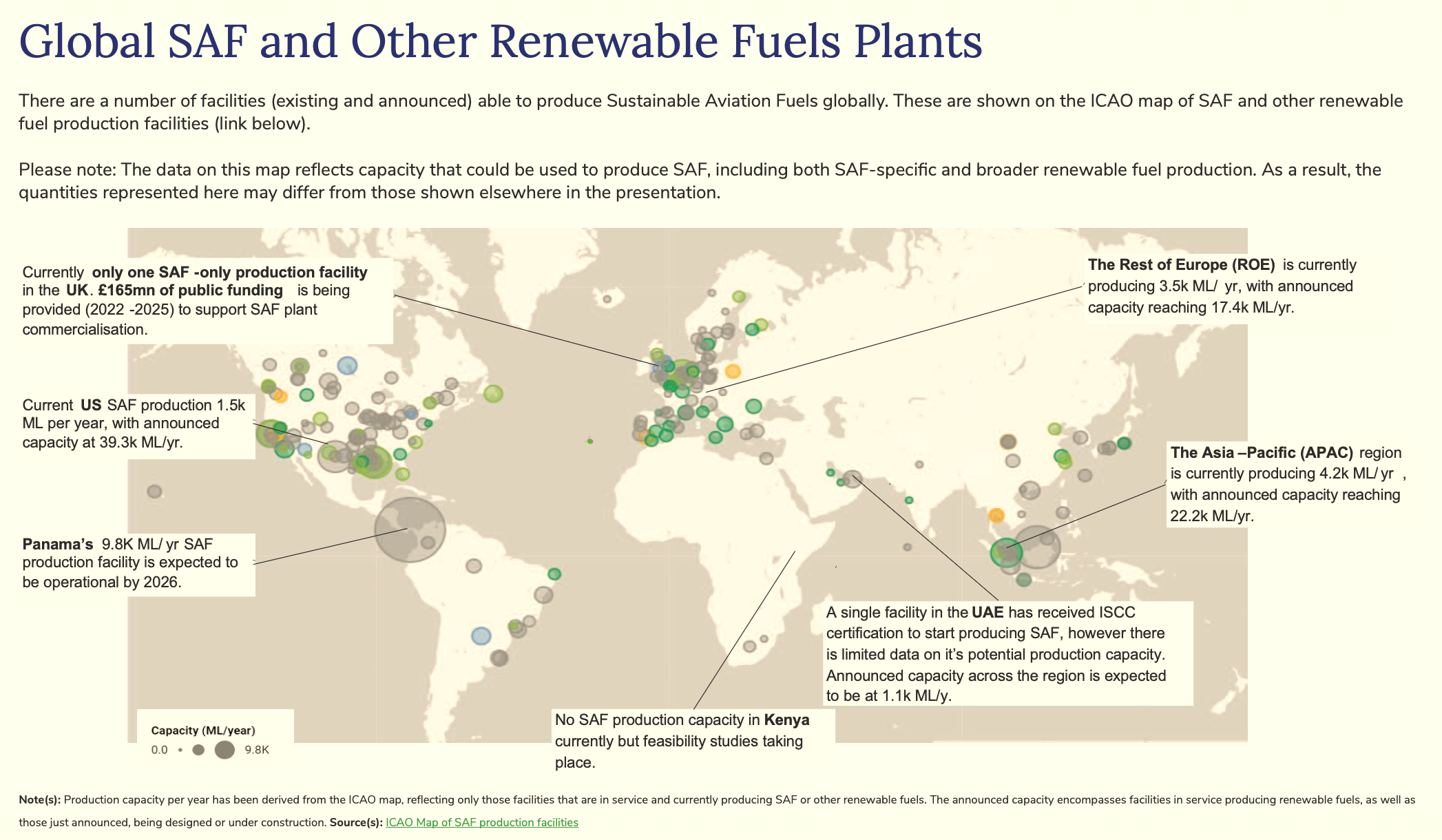
And that's before we start exploring production efficiencies, volume and cost. A snapshot of global production facilities, 2024:
You can read more in-depth analysis from this GFI report here:
Who's On the Runway?
As you can imagine, the revenue opportunity globally in a future SAF market is huge - some key players and their approaches noted below:

Reaching full potential biomass-to-SAF requires overcoming significant technological, economic, and logistical hurdles, but it is a highly promising pathway to decarbonise the aviation sector.
About the Author
Michael Sura

Michael Sura - Energy and transport analyst, strategist, and advisor, based in Slovakia 🇸🇰