
The Thermodynamics of Decoupling
How Transport Electrification and Distributed Renewables are Dismantling Global Oil and Gas Demand



A Global Transition
The global energy landscape has entered a phase of structural deceleration, with refined oil and natural gas demand facing permanent downward pressure. For decades, conventional energy modelling treated fossil fuel decline as a distant, linear process. However, a dual-force mechanism has accelerated this timeline: the deep penetration of structural electrification across transport and industrial sectors, alongside the rapid scaling of solar photovoltaics (PV) and battery energy storage systems (BESS).
This structural transition is unfolding against a backdrop of acute geopolitical volatility. The escalation of conflict in the Middle East has disrupted critical energy choke points, pushing Brent crude prices well past $100 per barrel and triggering massive volatility in natural gas markets.
Far from securing the lifespan of fossil fuels, these high prices have acted as an economic accelerant, eliminating inertia and forcing nations to de-risk their economies from volatile energy imports.
Data from leading energy institutes confirms that clean technology is now scaling fast enough to absorb new energy demand. According to Ember’s Global Electricity Review, low-carbon power generation grew by 887 TWh, outpacing global electricity demand growth of 849 TWh. This historic milestone marks the first time clean energy expansion has entirely neutralised global demand growth, forcing fossil-fuelled power into absolute structural decline.
The Primary Energy Fallacy and Transport Electrification
The core flaw in traditional models projecting long-term oil resilience is the Primary Energy Fallacy; a concept frequently highlighted by energy experts like Michael Liebreich and Paul Martin. Conventional analyses often conflate the total primary energy contained in a barrel of oil with the actual useful work delivered to the wheels of a vehicle.
This oversight ignores the stark thermodynamic divergence between internal combustion engines (ICE) and battery electric vehicles (BEVs):
- Internal Combustion Engines (ICE): Highly inefficient, converting only about 20% of the fuel's chemical energy into useful mechanical movement at the wheels, when accounting for a full Well-to-Wheel lifecycle. The remaining 80% is lost entirely as waste heat through the exhaust and radiator.
- Battery Electric Vehicles (BEVs): Operate at close to 80% well-to-wheel efficiency.
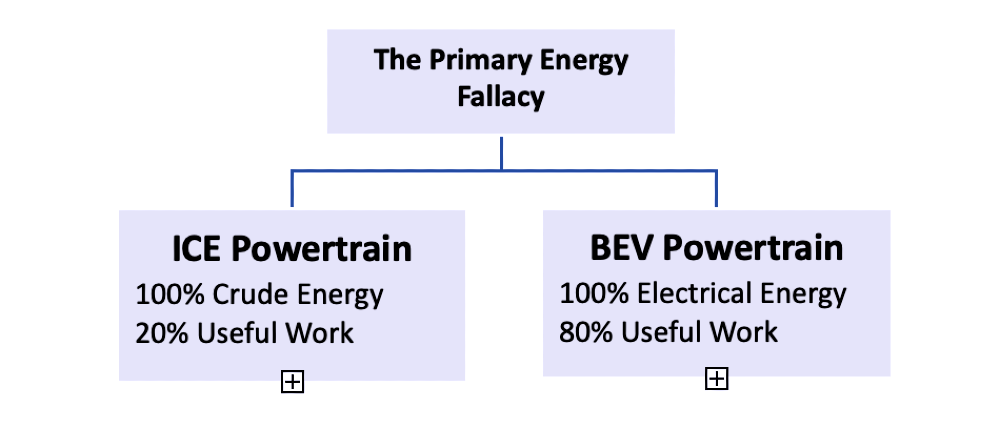
- Because BEVs require roughly a quarter of the raw energy input to carry the same loads over the same mileages, every megawatt-hour of renewable electricity deployed does not just replace an equivalent unit of oil; it displaces a vastly larger volume of primary fossil energy.

According to the Energy Institute’s Statistical Review of World Energy, global oil demand trends have structurally decoupled from GDP growth. Electric vehicle sales reached more than 25% of the global car market (surpassing 20 million units annually). The International Energy Agency (IEA) notes that fuel demand growth for road transport has remained structurally muted because of this shift. Ember reports that EV deployment displaced enough oil to account for 66 TWh of equivalent electricity demand growth, doubling its displacement impact from prior annual cycles.
As clean energy strategist Michael Bernard notes, this disruption is moving systematically up the weight class into medium- and heavy-duty trucking. Logistics operators, making procurement decisions strictly on a Total Cost of Ownership (TCO) basis, are abandoning the diesel drivetrain because plunging battery pack costs have brought heavy commercial vehicles to economic parity far faster than legacy models predicted.
While the transition of heavy transport and passenger cars dominates Western energy discourse, an even faster structural shift is occurring in emerging markets through the radical electrification of two- and three-wheelers. In nations like India, this segment represents the true frontline of oil demand destruction. As documented by global policy-trackers, India is undergoing an unprecedented electric tuk-tuk and e-scooter revolution.
Because two- and three-wheelers have historically relied on highly volatile petrol and diesel mixes, their wholesale conversion to electric drivetrains hits the refining sector's most lucrative product yields directly. Operating under the exact same parameters of the Primary Energy Fallacy, a battery-operated three-wheeler achieves an efficiency close to 80%, bypassing the staggering thermal waste of small, inefficient, air-cooled internal combustion engines. This micro-mobility transition proves that oil demand is being aggressively hollowed out from both ends of the vehicular weight spectrum simultaneously.
Off-Grid Industrial Displacement: Mining and Remote Power Systems
Refined oil products are experiencing simultaneous displacement in industrial niches where diesel was once the only technically viable fuel option.
- Electrification of Heavy Mining Equipment: Open-pit mining operations require massive energy inputs for haulage. High-horsepower diesel engines are actively being phased out by major mining conglomerates in favour of fully electric haul trucks, battery-electric load-haul-dump machines, and dynamic trolley-assist systems. The transition is driven by two commercial realities; eliminating underground diesel particulate matter to cut ventilation costs, and insulating massive corporate operational expenditures (OpEx) from global oil shocks.
- The Microgrid Revolution (Remote Power Generation): Remote industrial sites, agricultural hubs, and telecommunication towers have historically relied on non-grid diesel generator (genset) units. This captive diesel market is collapsing due to the modularity and radical cost deflation of Solar PV paired with BESS. Once the upfront capital expenditure of a solar-plus-storage installation is amortised, the operational marginal cost is near zero, completely eliminating the continuous fuel procurement and complex logistics costs of trucking diesel to remote areas.
The Real-World Friction of AI Data Centres vs. Renewable Momentum
A prominent counter-argument to the peak gas narrative is the exponential rise of Artificial Intelligence (AI) data centres, with some analysts projecting a massive surge in natural gas-fired generation; particularly Open Cycle Gas Turbines (OCGTs), to handle baseload and peak artificial intelligence workloads.
While tech firms are exploring interim workarounds, including re-purposing old aero-derivative gas turbines to bypass utility queues, this approach faces severe practical and economic limits:
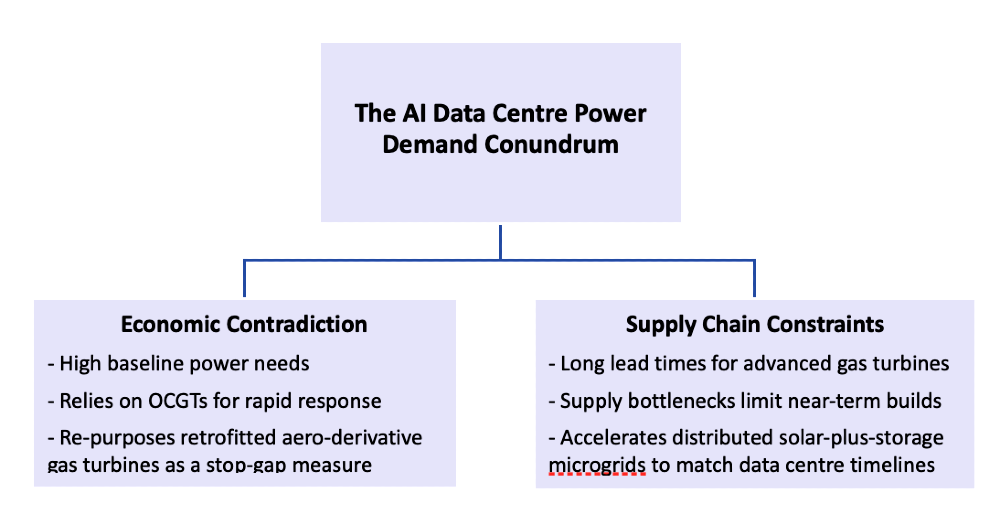
- Economic Contradiction: As Jan Rosenow and Michael Liebreich argue, relying on volatile, high-marginal-cost fossil generation contradicts the long-term economic mandates of tech companies. High gas prices and carbon penalties make OCGTs an expensive long-term bet. Instead of anchoring to a volatile gas grid, the industry is increasingly leaning into co-located, clean energy microgrids backed by power purchase agreements (PPAs).
- Supply Chain Constraints: The global supply chain for high-efficiency gas turbines is severely constrained, with waiting times stretching several years, making rapid gas-fired grid expansion physically impossible in the near term.

Crucially, the global power market is proving that emerging economies can entirely bypass the gas-expansion phase. Faced with the choice of expanding its power sector via liquefied natural gas (LNG) or clean infrastructure, Vietnam chose rapid energy expansion using solar coupled with utility-scale batteries, shielding its macroeconomy from international gas market volatility.
Similarly, India is expanding its solar, wind, and battery storage capacity at an unprecedented pace. Ember's data reveals a historic reversal: India’s fossil fuel-based generation fell by 52 TWh (-3.3%), driven by record additions in wind and solar output, completely upending expectations of fossil growth.
Natural Gas Demand Compression: Peak Plants and BESS Disruption
The structural displacement of natural gas by BESS is dismantling the traditional "bridge fuel" narrative. When battery storage pack prices for stationary applications fell by a staggering 45% (reaching record lows of $70/kWh), the economic competitiveness of natural gas-fired peaker plants dissolved.
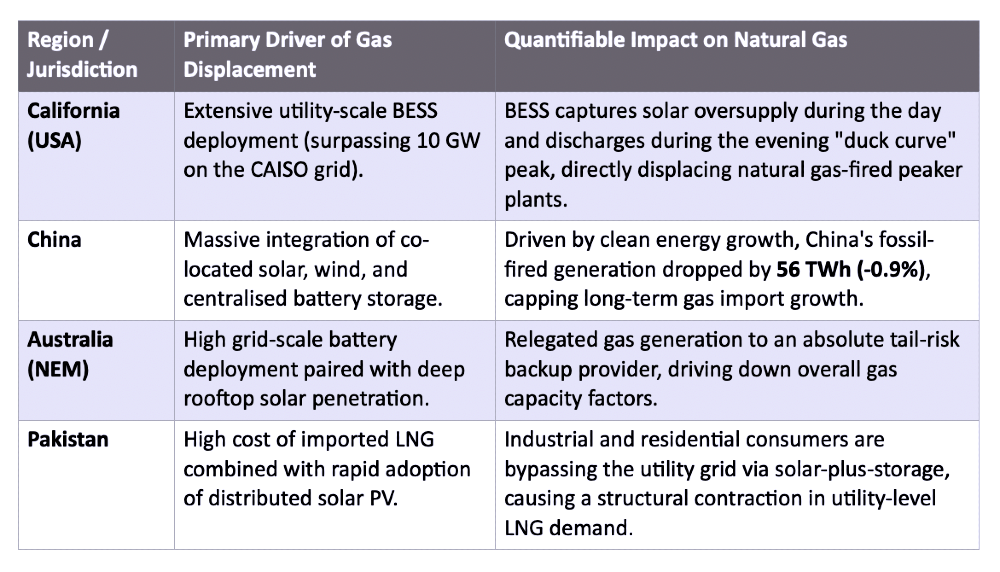
As energy experts like Dr Mark Jacobson have frequently pointed out, the thermodynamic inefficiency of burning gas for electricity cannot compete with the plunging levelised cost of energy (LCOE) of wind and solar-plus-storage.
This structural reality has severe implications for the global LNG market. The IEA highlights that over 80 billion cubic metres (bcm) per year of new LNG liquefaction capacity reached final investment decisions (FIDs) in the United States alone during the recent investment cycle. However, this massive wave of new supply is crashing into a global market where structural demand is being permanently hollowed out by renewables.
Geopolitical Shock as an Economic Accelerant
While long-term techno-economic trends dictate the direction of the energy transition, geopolitical events determine its velocity. The escalation of conflict in the Middle East has permanently altered the risk premium of fossil fuels. The IEA notes that recent geopolitical disruptions in the Middle East resulted in a significant loss of global LNG and crude oil flows, causing acute price volatility and driving international fuel costs back to levels reminiscent of the 2022 energy crisis. For importing nations, this financial burden proved entirely unsustainable.
Sustained high fuel costs act as an immediate tax on economic growth, eroding the primary barrier to the energy transition; the sunk capital tied to existing fossil-fuel infrastructure. When the cost of refined fuels exceeds the threshold of economic viability, the payback period for capital investments in solar, batteries, and electric fleets shrinks drastically.
Governments now view the energy transition through the lens of strategic national security rather than just environmental policy. A kilowatt-hour generated via local solar PV and retained in a domestic battery system carries zero geopolitical risk; a barrel of imported refined oil or a cargo of spot LNG carries infinite risk.

To put the scale of this substitution into perspective, Ember notes that global solar power generation increased by a record 636 TWh (a 30% increase). This single year of solar growth alone generated more electricity than could be produced by all the LNG exports transiting the Strait of Hormuz annually (estimated at 550 TWh).
Conclusion
The qualitative view that global refined oil and natural gas demand has crossed its secular peak stands up to rigorous semi-quantitative scrutiny.
The energy transition is no longer a prospective policy goal; it is a highly commercial, capital-driven reality.
The compounding growth of solar and wind has successfully decoupled energy demand from fossil fuel consumption.
While specific sectors like AI data centres present highly visual localised demand narratives, the overarching global data demonstrates that clean energy is scaling fast enough to neutralise these spikes, while simultaneously hollowing out the core transport and peak power markets that fossil fuel producers rely on.
Driven by the superior thermodynamics of EVs, the economics of renewables, and accelerated by acute geopolitical risk, the structural decline of global refined oil and gas demand is no longer a distant forecast; it is a transformation that is actively unfolding.

Dilip Patel - Energy industry consultant, advisor and lecturer with over 42 years international experience in large-scale gas, LNG, and energy infrastructure projects.
References
Ember - Global Electricity Review
Application: Used for the foundational 2025/2026 power generation data, specifically the landmark metric where low-carbon power additions (887 TWh) outpaced global electricity demand growth (849 TWh), as well as the specific grid data.
IEA - Global EV Outlook
Application: Used to verify the global active electric vehicle fleet tracking (surpassing 65 million vehicles cumulatively) and the market penetration metrics showing electric cars capturing 25%–28% of global new car sales.
Energy Institute (EI) – Statistical Review of World Energy
Application: Used for baseline historical refined oil and gas demand data, global liquid fuel consumption trends, and tracking the structural decoupling of oil demand from global GDP growth over the past 7 to 8 years.
International Energy Agency (IEA) – Oil Market Report
Application: Used for the macro-level demand destruction metrics, structural downward revisions to global crude consumption baselines, and identifying global refining capacity shifts (middle distillate crack spread volatility).
U.S. Energy Information Administration (EIA) – International Energy Outlook
Application: Grounded the reference figures for average crude oil refining fractional distillation yields (the strict volumetric limits of obtaining 74.7 litres of petrol and 44.5 litres of diesel from a standard 159-litre barrel of crude).
ISO 13443 Standards Documentation – Natural Gas: Standard Reference Conditions
Application: Utilised to verify the thermodynamic expansion equations for natural gas at 15°C and 101.325 kPa, ensuring the scientific precision of the 1 tonne LNG = 1,360 m3 gas conversion factor.
International Energy Agency (IEA) – Global EV Outlook 2026: Growing sales amid an energy crisis
Application: Grounded the global market scaling dynamics for two- and three-wheelers, verifying that the sector represents the most heavily electrified road transport segment on Earth. Validated that global electric light vehicle sales reached 11 million units annually, pushing the cumulative active stock past 150 million units globally, heavily anchored by China and the emerging Asia-Pacific corridor.
Federation of Automobile Dealers Associations (FADA) / Society of Indian Automobile Manufacturers (SIAM) – Indian Retail Mobility Database 2025/2026
Application: Provided the core regional operational metrics for India's transition, showing that electric models have aggressively captured a dominant 60% to 70% share of all three-wheeler sales nationwide, effectively accelerating the structural decline of legacy internal combustion engine (ICE) and compressed natural gas (CNG) commercial options.
The Telegraph – Global Health, Climate and People Series (2025/2026)
Application: Cited to provide real-world qualitative and social context for India’s decentralised "electric tuk-tuk revolution" across urban and peri-urban transport corridors, illustrating how small fleet operators achieve rapid cost-of-ownership savings by bypassing high petroleum pump prices.
Strategic Opinions
With thanks to:
- Dr Jan Rosenow (Regulatory Assistance Project - RAP)
- Dr Mark Z. Jacobson (Stanford University)
- Paul Martin (Spitfire Research / Hydrogen Science Coalition)
- Michael Bernard (TFIE Strategy)