The Clean Steel Challenge - Iron Ore Electrolysis for the Win?
Steelmaking is on the hard to abate list of large-scale global emissions culprits - what's the best route to decarbonisation?



Could iron-ore electrolysis be the revolutionary, zero-carbon alternative to traditional blast furnaces?
Steelmaking accounts for approximately 8% of global fossil-based CO2 emissions. The dominant manufacturing process, which produces 90% of the global primary steel, is via blast furnace / basic oxygen furnace.
This utilises metallurgical coal (coke) as a chemical reducing agent to remove oxygen from iron ore. This reaction inherently generates large quantities of CO2.
What are the different options for decarbonising steel production, and is iron-ore electrolysis the best way forward?
The DRI option
Direct Reduced Iron (DRI) accounts for roughly 7-10% of total global primary steel production. This method utilises methane (natural gas) and injected carbon to extract oxygen from iron oxide.
DRI reduces emissions by approximately 30% when compared to traditional blast furnaces. However, the steel produced still has a significant carbon footprint, since most DRI facilities use methane / natural gas (CH₄) for heating and reducing iron ore.
DRI can also utilise hydrogen as a reducing agent instead of methane. This is a pathway that many companies have pursued in recent years. The key challenge is getting green hydrogen at a viable cost to actually reduce overall emissions.
In the DRI process, iron ore pellet reduction occurs in a shaft furnace where the temperature can be relatively low, around 800℃, instead of the usual 1600℃.
Depending on the facility, DRI fed into a blast furnace as hot briquette iron (HBI), enables the blast furnace to run more efficiently and use less coke. Alternatively, a facility could use an Electric Arc Furnace (EAF) instead of a traditional furnace.
The EAF offers a further route to decarbonisation by running on direct renewable electricity. We won't dive into EAF here today, but it represents an interesting solution, one aspect being that it utilises scrap steel as its raw material input.
Therefore, it is not primary steel production, but it is one tool we can use across the wider steel decarbonisation challenge, making use of a circular approach.
The MOE Option
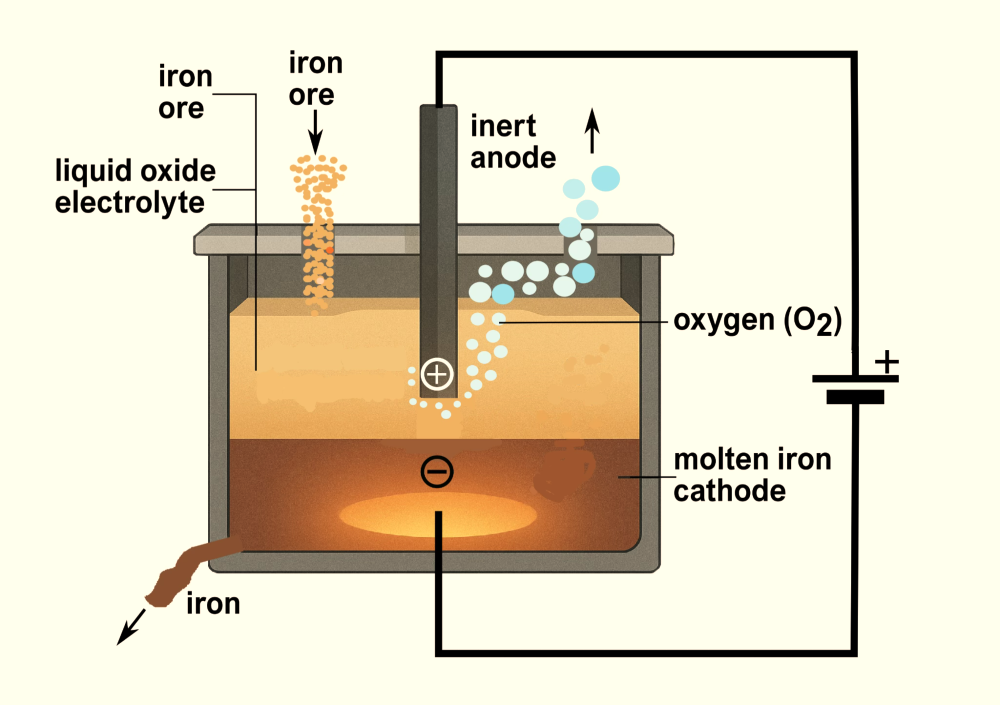
Molten oxide electrolysis (MOE) is a carbon-free steelmaking technology that uses electricity instead of coal to convert iron ore into liquid metal. Operating at extreme temperatures (1,600 °C), it dissolves iron ore in a molten electrolyte and uses an electric current to separate the iron from oxygen, releasing only pure oxygen as a byproduct.
For example, when processing iron ore (hematite), the fundamental overall chemical equation is:
2Fe2O3(l) = 4Fe(l) + 3O2(g)
Iron ore (such as hematite Fe2O3) is fed into a bath of molten oxides (often a mixture of MgO, CaO, and SiO2). This mixture acts as the solvent, heated to extreme temperatures, 1600℃ until converted to a glowing liquid.
The positive electrode (anode) is submerged directly into the molten oxide bath. Made from engineered materials (like specific transition metal alloys, e.g. iron-chromium alloys, or precious metals like iridium) that are uniquely designed to survive the highly corrosive, high-temperature oxidative environment without degrading.
The negative electrode (cathode) is located at the bottom of the melting container. When a direct electric current (DC) is applied, the electrical energy breaks the chemical bonds of the iron oxide.
At the anode, the oxygen ions within the molten bath travel to the immersed inert anode and lose electrons (are oxidised). This generates pure oxygen, which bubbles safely to the surface to be collected. At the cathode, the metal ions gain electrons (are reduced) and turn into liquid metal.
Because the newly formed liquid metal is much denser than the surrounding molten oxide electrolyte, it sinks to the bottom of the cell - ready to be continuously tapped as high-purity liquid metal.
What are the challenges?
An inert anode is the most critical and challenging component in MOE electrolysis. Finding a stable, inert, and affordable anode material for carbon-free metal production is the real problem.
At MOE temperatures of 1600℃, to maintain the fluidity of iron oxide, the most common electrode materials quickly melt, change shape, or dissolve.
Preventing the aggressive oxidisation of the anode material is a critical exploration theme for researchers, who are trying to develop protective, self-healing oxide scale layers in response.
Chromium–iron (CrFe) binary alloys are a standard choice. These alloys develop a self-healing, conductive passivation layer of chromium-aluminum oxide.
Iridium and Platinum group metals have excellent inert properties because they resist oxidation. However, they are very expensive, which limits their commercial use.
Energy Intensity
The MOE process consumes massive amounts of electricity. At $20/MWh, the electricity costs roughly $80/ton of steel produced. If electricity costs $50/MWh, the price of steel jumps to $200/ton.
In contrast to traditional, multi-billion-dollar integrated steel plants, MOE employs modular cells (like those used in aluminum smelting potlines). This reduces the financial barrier, enabling operators to start with smaller capacities and scale up production gradually.
Boston Metal is a world-leading company that develops MOE. The company is based in Woburn, Massachusetts, with its Brazilian subsidiary, Boston Metal do Brasil, based in Coronel Xavier Chaves, Minas Gerais. MOE is Boston Metal's patented platform technology.
 Boston Metal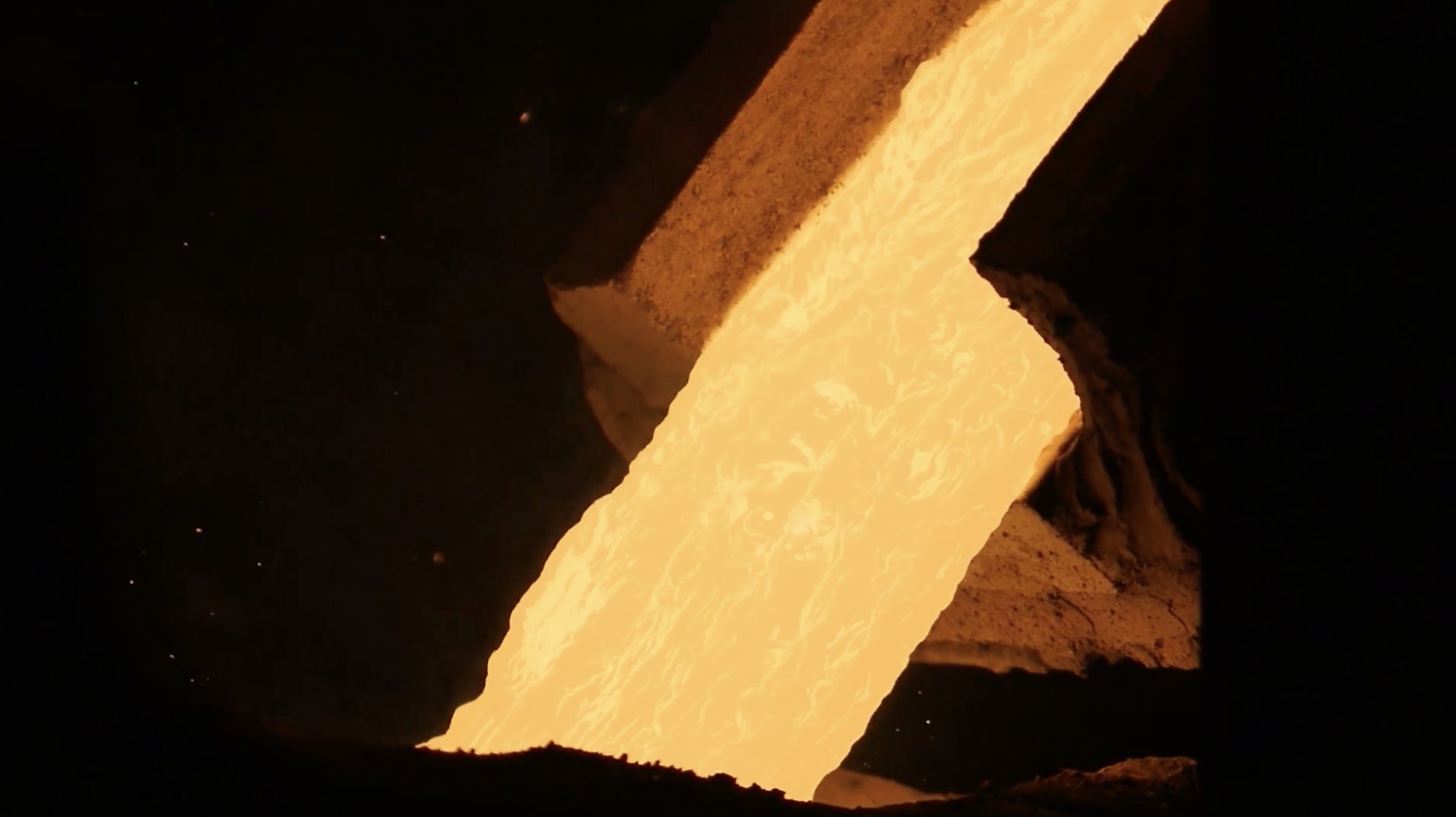
MOE represents an elegant way to produce clean steel, where the byproduct is oxygen - a dramatic shift from our current production processes.
When powered by renewable energy (like wind, solar, or hydro), the MOE process produces zero CO2. The sole emission is oxygen, rendering the iron-making stage carbon-free.
The competitive horizon looks promising for MOE. Green steel production uses expensive green hydrogen to reduce iron ore instead of coal.
MOE can bypass green hydrogen supply chain and process complexity and use green electricity for steel production directly.
Future Pathway
The flexibility of MOE as a modular solution is mirrored in the flexibility of its raw material inputs.
Traditional blast furnaces need specifically sourced, high-quality iron ore. MOE can effectively handle various global iron ore grades, even low-quality mining waste, increasing the availability of usable raw materials.
This opens up potential market adoption at scale across geographical regions; something that green hydrogen-based DRI has failed to deliver.
When the inert anode problem is successfully solved, MOE becomes a highly prospective and revolutionary method for clean steel production.
About the Author
Michael Sura
Michael Sura - Energy and transport analyst, strategist, and advisor, based in Slovakia 🇸🇰