How BESS Mitigates Gas Use
BESS rebalancing the geopolitical risk of gas for power generation


Battery energy storage systems (BESS) are an important tool to support grid reliability and allow better integration of California’s abundant renewable energy sources into the electricity grid.
However, consumption of electricity is notoriously unstable, peaking in the mornings and evenings when residential and industrial demand surges. Historically, grid operators relied on gas peaker plants as the primary method for meeting surge demand on the grid.
How can BESS help shift the balance in clean power generation, pushing gas-fired peaker plant generation out of the mix?
Scaling BESS Capacity
California is a global leader in deploying Battery Energy Storage Systems (BESS), with nearly 17 GW (approx. 64GWh) of installed capacity by 2026, to support grid reliability and seamless integration of renewable energy sources.
California has a plan to install 52 GW of battery storage capacity by 2045 to meet its goal of 100% clean, fossil-free electricity. To meet this goal, the state, besides installing BESS, continues to expand the deployment of solar, wind, and geothermal capacity.
Batteries are now used to fulfil high local capacity demands during peak periods. A role that was formerly performed by expensive and polluting "peaker" gas plants. BESS will help to retire natural gas-fired power plants by 2045.
California Impact
BESS serves as a direct replacement for gas-peaker plants, storing electricity during periods of low demand or excess renewable generation (sunny/windy days) and discharging it when demand is high, or prices are high.
Gas plants can take 10–30 minutes to reach full power; BESS responds in milliseconds and can "shave" demand peaks without firing up a gas turbine.
BESS can provide crucial "ancillary services," such as frequency control and voltage support, which keep the grid stable.
BESS set a record for power delivery to California's electricity grid on March 29, 2026. At 7 PM, BESS achieved an output of 12.28 GW, which accounted for 43.8% of the grid's demand.
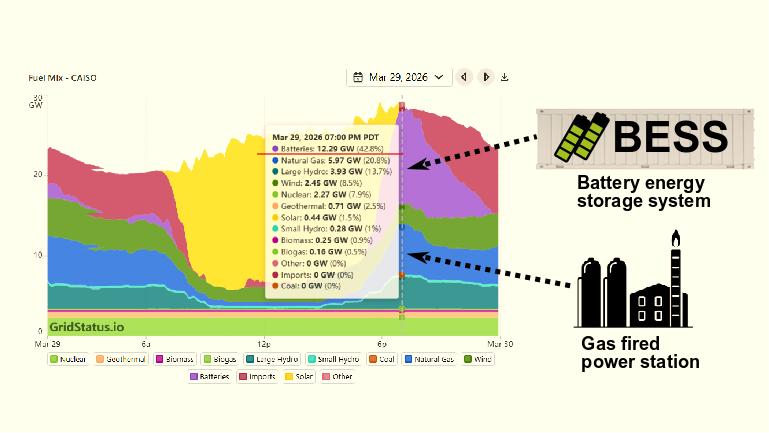
BESS contributes as much as 9% of the electricity to California's energy grid in just one day. This does not refer to generated energy, but is the time-shifted supply of excess solar energy and other renewable energy produced during peak sunlight hours, which was stored in BESS.
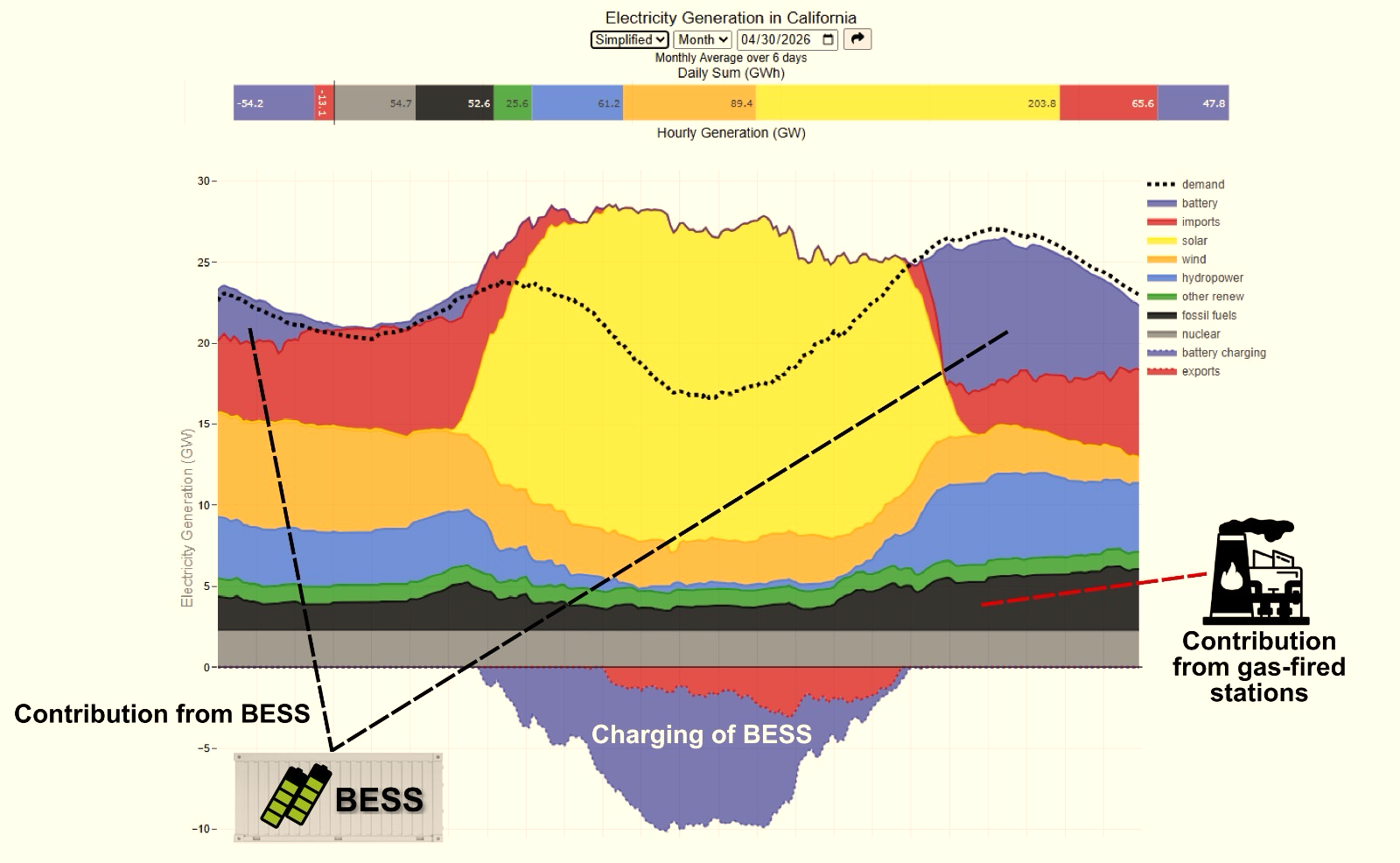
In the image below, 30th April, we see how BESS eliminates electricity generation from gas peakers. BESS is charged during the day when photovoltaic systems produce more energy than demanded, and then BESS discharges when there is high electricity demand, which occurs in the evening and morning.
California Dreaming
California serves as an example for other states and nations regarding clean power transformation, integrating BESS into the electrical grid. Other states can gain valuable experience and information from this - the California Independent System Operator (CAISO) shares in its published documents.
From 2018 through 2026, BESS capacity in California increased from 500 megawatts (MW) to approximately 17 GW of BESS online.
California's goal is 100% clean electricity by 2045, and it will need the installation of 52 GW of BESS capacity, with the corresponding energy capacity estimated to be over 200 GWh.
Installing BESS is a way to avoid importing LNG, both emission-heavy throughout its supply chain and at geopolitical risk - demonstrated by the current crisis at the Strait of Hormuz. Therefore, installing BESS will not only enable decarbonisation but also eliminate dependence on imported fossil natural gas.
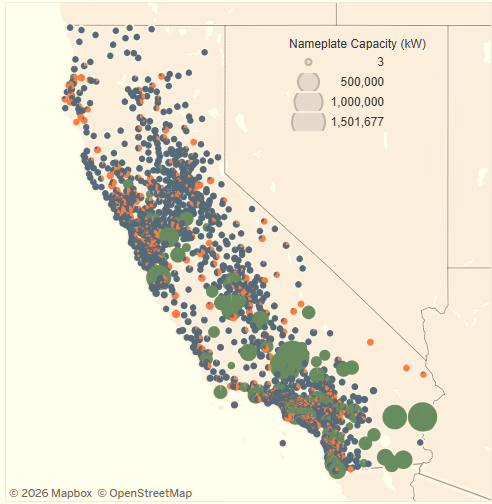
BESS in California are predominantly located in regions with high solar generation and areas with critical grid needs.The co-location of PV solar plants and BESS has proven effective: by sharing the grid connection infrastructure, it minimises the curtailment of excess energy, reduces capital costs, and optimises energy management.
Market Structure
Grid-scale BESS in California is not owned by a single entity, but by a mix of independent power producers, large utility companies, and private equity investors.
BESS in California's CAISO market primarily generates revenue by combining long-term capacity Resource Adequacy (RA) contracts with active trading in merchant markets (Energy Arbitrage and Ancillary Services).
As of early 2026, roughly 80% of total revenue for contracted assets is derived from RA
The remaining revenue share is through capitalisation on price differences between times of low demand (high supply) and high demand (low supply), plus ancillary services (to maintain grid reliability and frequency).
California is a real-world example that a modern economy can transition towards being an electro-state.
This is an inspiration for Europe in achieving its goal of energy sovereignty.
European Progression
In many EU countries, gas-fired peaker plants frequently serve as the price-setting units in the EU's merit order, influencing wholesale electricity prices when affordable renewables (wind/solar) fall short of demand.
Elevated natural gas and carbon prices significantly increase electricity costs because the most expensive gas-fired peaker plants can meet demand, setting the price for all electricity supplied.
This creates an opportunity for BESS to store clean power during excess generation of renewable energy (wind/solar) and release it when demand is high, reducing the need for gas-fired peaker stations.
Burning fossil gas is typically the most expensive way to generate electricity, and many EU countries are now deploying BESS at scale, which can eliminate the need for gas-fired peaker stations. BESS can also mitigate, and in some scenarios eliminate, negative electricity prices caused by high renewable energy production.
Countries such as Italy and Romania serve as examples of this shift towards BESS usage.
Italian Activation
Italy generates 57% of its electricity from fossil fuels, mainly from imported natural gas, and only 43% from renewable sources. However, Italy is speeding up its renewable energy production, decreasing reliance on imported gas, and achieving EU climate goals.
In 2026, Italy is one of the leading European markets for BESS; the country has connected 1.9 GW of large BESS.
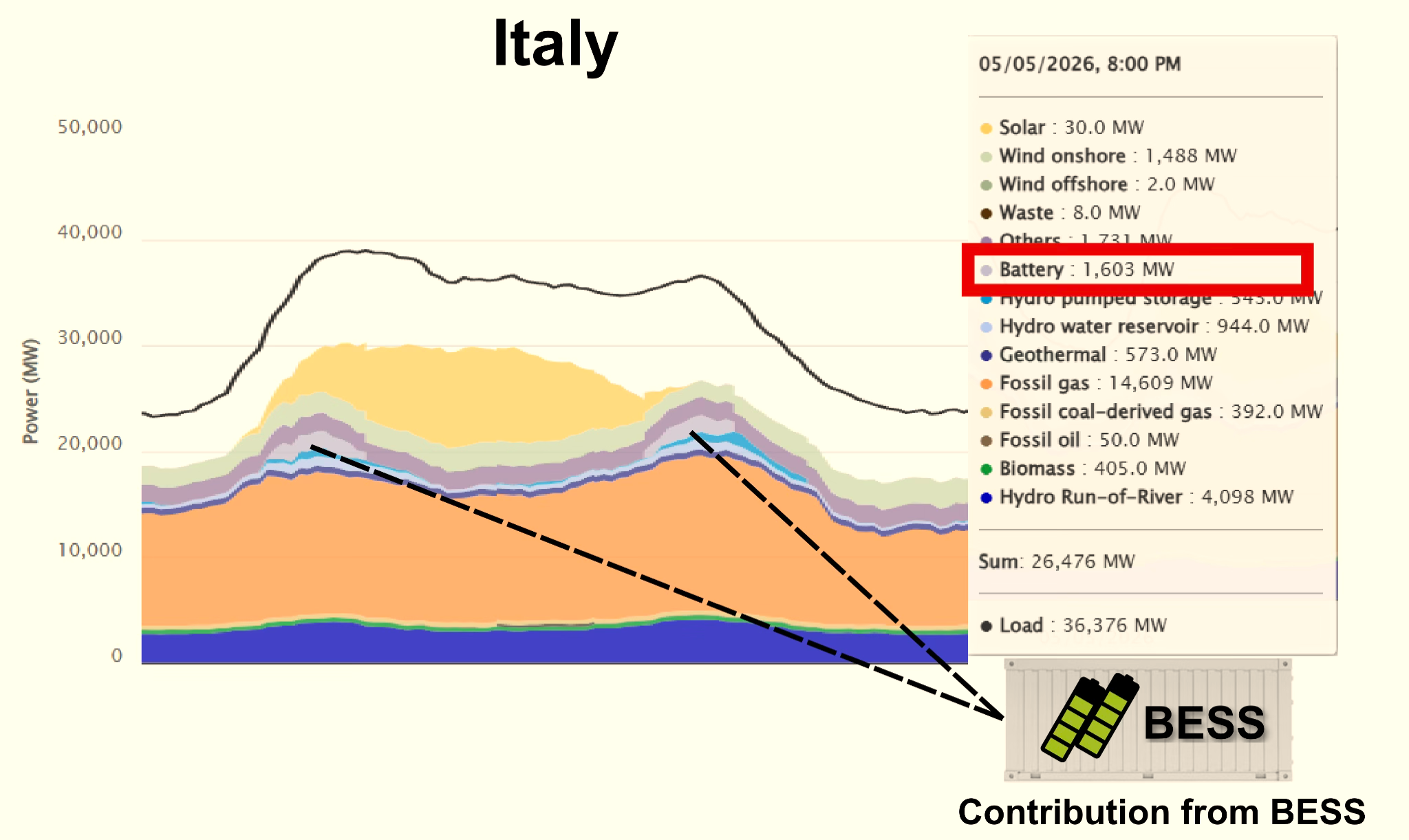
As seen in the image, BESS was able to supply up to 6% of the total power in the Italian grid, thus replacing the natural gas peaker with a capacity of 1603 MW at this moment.
Italy would like to add approximately 15 GW of BESS capacity by 2030. California illustrates a potential scenario for Italy.
In 2021, California's grid-scale battery capacity matched Italy’s current level (2 GW), but it surged to 15 GW in just five years.
Romanian Traction
Romania is experiencing a rapid, surprise boom in BESS. Proving that solutions to marginalise gas generation are accessible to all countries and economies, no matter the location.
Currently, Romania has installed approximately 500 MW of large BESS, but the country is rapidly accelerating its BESS sector - targeting up to 5 GW of capacity by the end of 2026, driven by EU-backed funding.
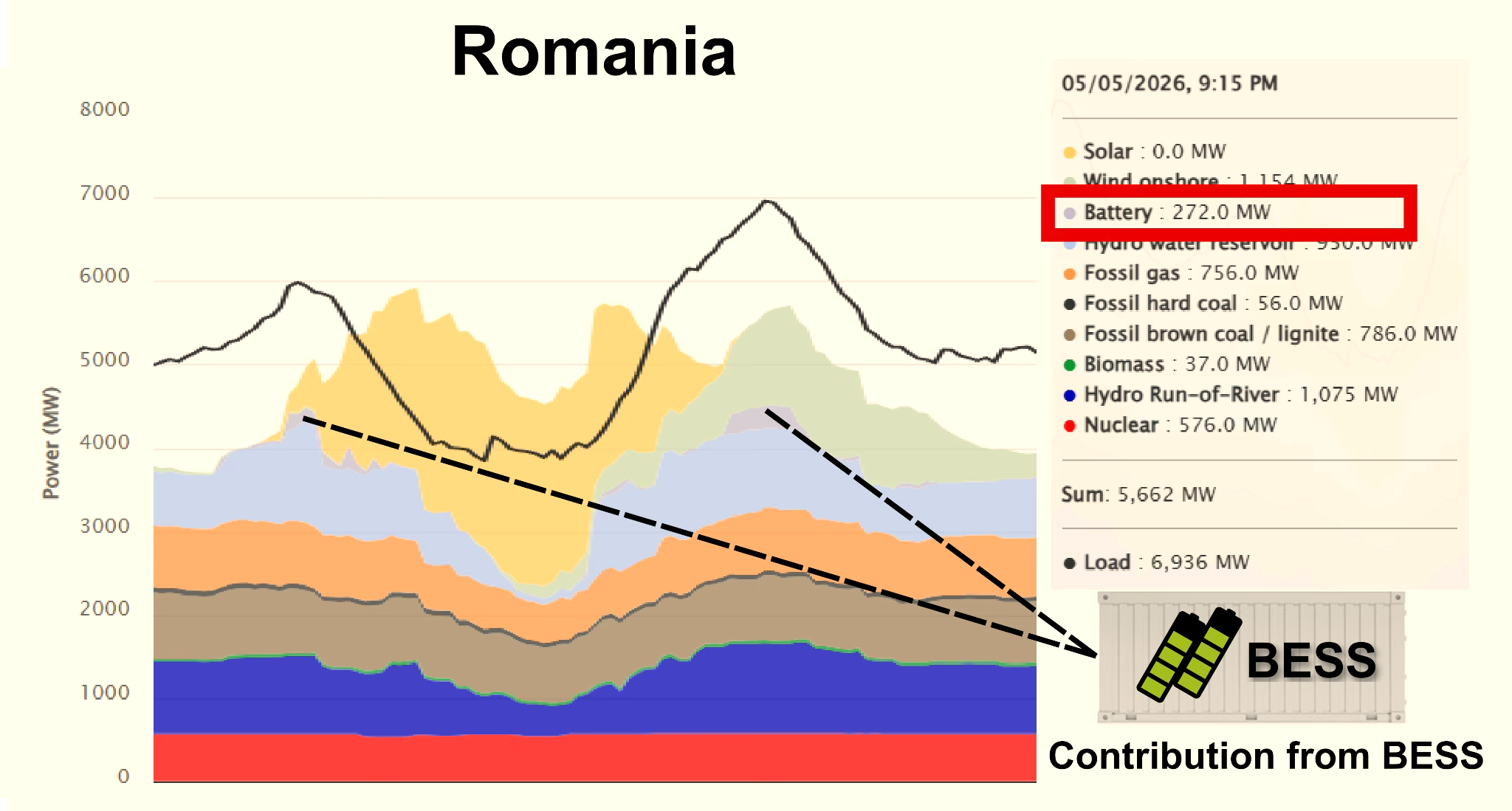
From the image, it is evident that BESS could deliver as much as 4.7% of the overall power supply in the Romanian grid.
By 2025, fossil fuels made up 34% of Romania's energy supply, while renewable sources provided about 44.7%, with hydropower being the biggest part, and nuclear energy contributed 21.3%.
European Pathway
Grid-scale BESS projects are expected to increase throughout the EU, particularly in areas where battery capacity is low compared to solar and wind.
BESS are now installed in almost every European Union member state, though a small group of countries dominate most of the market capacity.
The leading countries are Italy, Romania, Belgium, Lithuania, France, Germany, Ireland, but this order will change as countries and markets rapidly accelerate BESS capability.
The UK in particular, has major challenges around wind generation curtailment and can therefore expect a significant market response in the coming years.
Estimated at 8.3TWh in 2024, rising to 10TWh in 2025, at a cost of over £1bn to the economy per year.
More and more EU countries recognise the importance of BESS in increasing the stability of the electricity grid, better integrating renewables, and phasing out gas peakers.
For both the reduction in emissions and climate impact, and the cost of generation and inherent instability of geopolitically volatile gas supply chains, this can't come soon enough.
About the Author
Michael Sura
Michael Sura - Energy and transport analyst, strategist, and advisor, based in Slovakia 🇸🇰