Why 'Hydrogen Blending' is Another Wrong Turn
Hydrogen blending, yet another "predatory delay" tactic.


Hydrogen, always the next 'big thing' with politicians and investors. We hear about the 'hydrogen economy' and building 'Europe's backbone infrastructure'.
The challenge is actually finding a techno-economic argument that supports H2, and therefore offtake agreements and actual market traction.
One perceived route to market is to blend hydrogen into existing gas networks, keeping the status quo and the gas-based economy flowing.
Why is hydrogen blending another "predatory delay" tactic?
Hydrogen blending trials
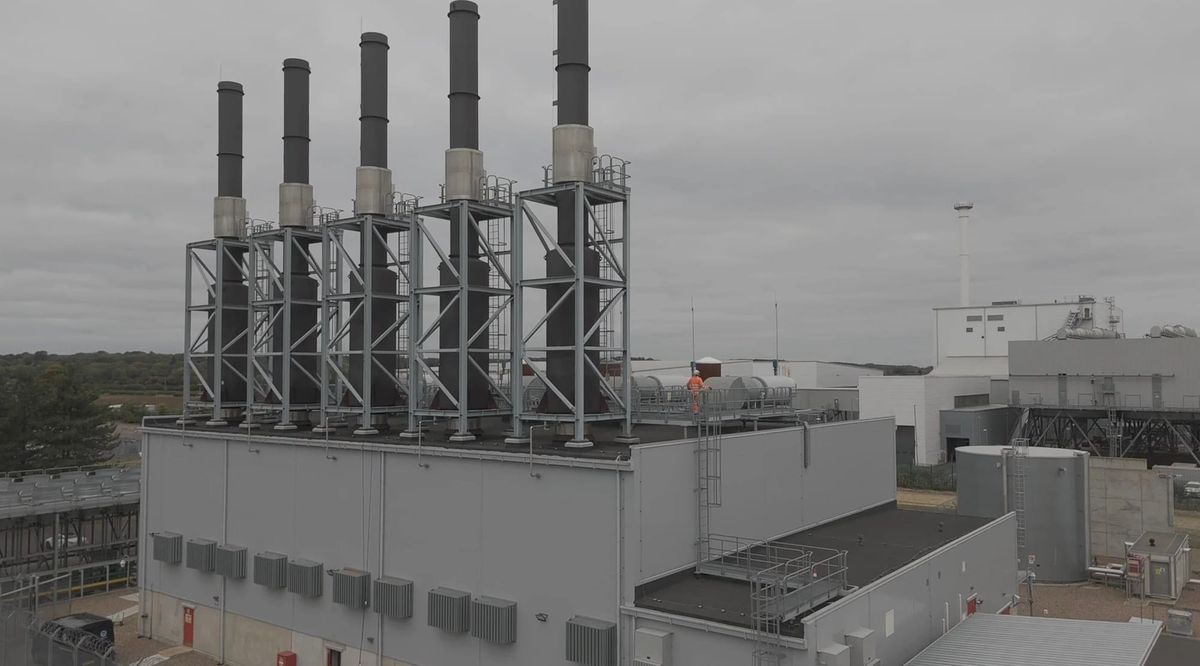
In late 2025, a successful trial mixing 2% green hydrogen gas concluded at the Brigg Power Station in North Lincolnshire. This marked the first time that the UK's gas grid infrastructure transported a blend of green hydrogen and natural gas for electrical generation.
Centrica and British Gas conducted the trial. As you might expect, they have a significant interest in demonstrating that hydrogen gas blends can work with the current UK infrastructure.
You can read more of Centric's warm words on the benefits of this trial here, as they 'power up UK's net zero ambitions'.

Technical aspects of blending aside, it needs an end delivery point - people's homes and businesses.
The UK H2 for Home Heating trials didn't go down too well. The Chemical Engineer, read more.
THE UK has shelved plans to trial using hydrogen to heat homes at town-scale until after 2026. The decision follows failed attempts to establish smaller village trials in Whitby and Redcar.
And the impact here, from Juliet Phillips, the head of UK energy at E3G:
Discussions on hydrogen for heating are an unhelpful distraction that muddy the waters on the future of how we heat our homes,” she said. “Widespread use of hydrogen for heating is widely understood to be an extremely expensive and inefficient way to meet net zero targets, which could exacerbate fuel poverty.
And the UK Government's independent advisors, the Climate Change Committee:
deeming there to be “no role” for hydrogen in home heating
Seems to be some conflicting views in messaging and outcomes. I wonder why they continue to pursue this path...
It's not just the UK
Several hydrogen trials related to gas blending are currently taking place across Europe. The Netherlands, Germany, and Portugal are all exploring the use of hydrogen in household devices, experimenting with blending hydrogen gas into their existing setups, or adjusting their infrastructure to transport pure hydrogen in the future.
By 2030, the Portuguese government is targeting a 15% green hydrogen and natural gas mix in all domestic supplies.
China is not immune to hydrogen #hopium either.
Early in 2026, China launched the largest hydrogen-blending pilot project in Weifang, Shandong Province, delivering a hydrogen-natural gas mixture to 100,000 households.
The facility can safely adjust hydrogen blending ratios from 0% to 10%, which helps to reduce the nation's reliance on imported natural gas and significantly cuts carbon dioxide emissions.
We do not know what type of hydrogen China used to blend with natural gas, but if it is [black] fossil hydrogen produced from coal, it does not help to reduce CO2 emissions at all.
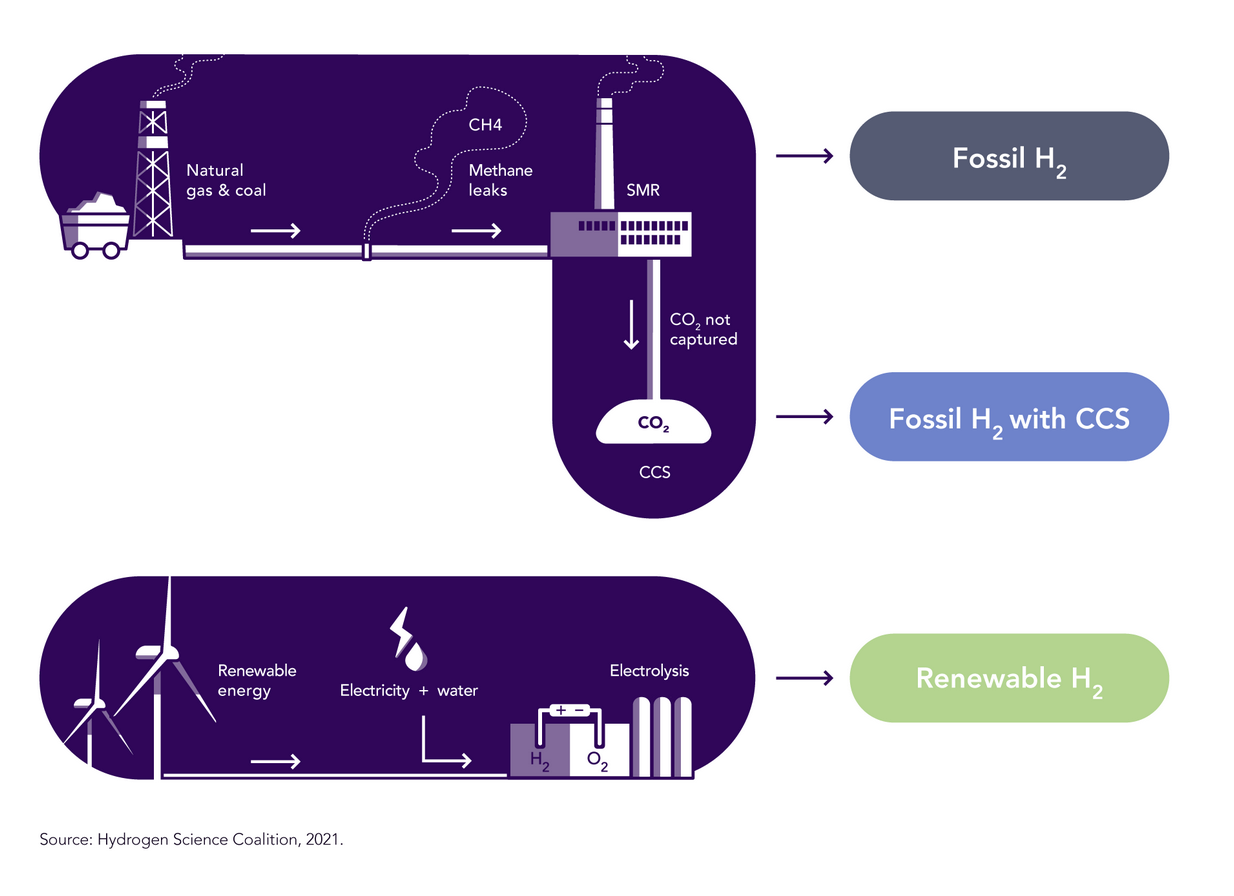
More excellent resources and reading from the NFP independent Hydrogen Science Coalition.
Fossil fuels produce 99.9% of global hydrogen. There is a global market of approximately 100Mt of fossil derived hydrogen to decarbonise to 'green' hydrogen, before we consider blending into the gas grid.
We need to replace fossil hydrogen with green hydrogen to produce green ammonia, green methanol, green steel, etc - the more challenging industrial applications, where direct electrification solutions are less cost competitive, or in earlier stages of technological maturity.
Why are we blending anyway?
Blending into natural gas pipelines, also known as hydrogen blending, is a strategy to inject hydrogen into existing natural gas infrastructure. The strategy intends to decrease CO2 emissions as hydrogen atoms take the place of methane atoms during combustion.
CO2 is the most emitted greenhouse gas on Earth (at around 75%). CO2 traps infrared radiation (photons) with a wavelength of 15 μm (micrometers), stopping photons from leaving the atmosphere. Trapped photons cause the bonds between the carbon and oxygen atoms to vibrate.
CO2 molecules eventually release these photons. Some photons escape into space, but some bounce back into Earth’s atmosphere where their (heat) energy remains trapped and they cause the effect of heating the atmosphere. CH4 strongly absorbs infrared radiation between 3.5 and 8 μm.
The surface temperature of the sun is 5480 °C. It emits radiation with wavelengths in the 0.2 to 3.0-micrometer range (After Mackenzie, 2003).
Incoming light from the sun of 0.2 to 3.0 μm is not absorbed by CO2 or CH4, but when the Earth re-emits, it has a longer wavelength, in the infrared spectrum, and CO2, CH4, and other Green House Gases trap it.
Proponents of hydrogen blending believe that injected green hydrogen makes the mix of hydrogen and natural gas less fossil-dense. There is logic to reducing the impact of CH4 methane, but there are better ways.
A reminder that methane is a more potent GHG than CO2 in the near term:
Over a 20-year period, methane's GWP is approximately 84 to 87 times that of CO2, indicating its strong short-term warming effect.
Over a 100-year period, methane's GWP decreases to about 28 to 36 times that of CO2, reflecting its shorter atmospheric lifetime compared to CO2.
More technical comparisons here.
But do the claims and attempts via blending to reduce emissions stack-up? Let's examine this closely.
The apples for apples reality
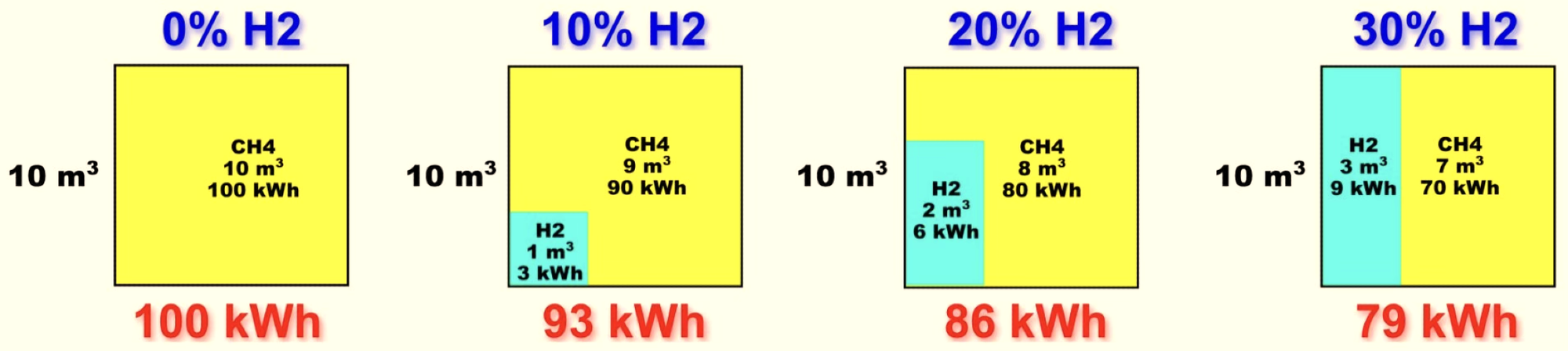
Under ambient conditions (20°C // 101kPa), 10m³ of natural gas (CH4) contains 100kWh of energy. By comparison, 10m³ of hydrogen (H2) contains only 30kWh of energy.
Our 10m³ of 100% natural gas with 100kWh, when blended to a 10% mixture of hydrogen and natural gas, contains only 93kWh of energy.
Higher ratios? 20% delivers 86kWh, and 30% delivers 79kWh. This gives us an energy density problem.
Spun the other way, to achieve an energy of 100kWh from a blended H2 + CH4 mixture, we need to burn:
114% at 20% (H2+CH4) mixture
121% at 30% (H2+CH4) mixture
The higher content of hydrogen makes the (H2+CH4) mixture leaner - we need to burn more of the blended gas mix to achieve the same energy transfer.
What do we actually get?
Continuing our blended mix analysis, what impact does it have on the key comparison metric, kg/CO2?
Burning 107% mixture with 10% H2 blend (H2+CH4) contains energy of 96.3kWh of CH4 and 3.7kWh of H2. Its combustion produces 2.65 kg / CO2.
Burning 100% of the 10% H2 blend (H2+CH4) contains energy of 90kWh of CH4 and 3kWh of H2. Its combustion produces 2.475 kg / CO2.
This means that 10% blending of H2 into natural gas will not reduce CO2 emissions by 10%, but only by 3.7%.
Hydrogen blending does not achieve the CO2 reduction and emissions impact that industry advocates and lobbyists suggest.
Infrastructure challenges
Blending hydrogen into existing natural gas pipelines for heating and power is an inefficient and potentially unsafe decarbonisation strategy.
Key considerations:
Poor carbon reduction - hydrogen has a much lower energy density by volume than methane, and blending 10% hydrogen into a pipeline by volume, only reduces CO2 emissions by around 3.7%.
Pipeline damage - steel pipelines and valves under high pressure can suffer from "hydrogen embrittlement". Hydrogen atoms accelerate metal embrittlement and lead to cracks and safety risks over time.
Ancillary process equipment - any attempts to scale H2 into an existing gas grid will require changes to compressors, valves and other associated equipment at significant capex.
Safety risk - Because hydrogen is a much smaller molecule than methane, it easily leaks from pipelines and household fittings.
Conclusions
We have explored how hydrogen blending does not make natural gas much cleaner when burnt. The likes of the CCC and other well-regarded scientific and assessment bodies have pushed back on H2 for home heating, via blending into existing networks.
Primarily because there are simpler, direct electrification changes that are more efficient - replacing gas boilers with heat pumps and gas hobs with induction hobs, is the best way forward in residential decarbonisation.
This is another roll of the dice for the fossil fuel industry, looking to keep gas flowing and consumers burning it, in whatever future version of a declining industry is obtainable.
I see H2 as a "predatory delay" tactic of the natural gas lobby - seeking a license and taxpayer subsidy to support the burning of natural gas for longer, and leveraging the stranded assets of the aged gas network.
About the Author
Michael Sura

Michael Sura - Energy and transport analyst, strategist, and advisor, based in Slovakia 🇸🇰