
How EV's Help Reduce Oil Demand
EV's leading the consumer push back against geopolitical oil shocks



The world consumes approximately 106 million barrels of oil every day - an incredible number. The latest geopolitical crisis, this time in Iran, has brought this huge dependency sharply into focus for the fossil fuel transport economy.
How can the shift to EV help mitigate this impact?
The USA consumes 20 million barrels every day, followed by China at 16 million barrels. China is the biggest importer of oil in the world, as the USA has significant domestic production, around 14 million barrels per day.
Automotive Impact
According to various data sources, a typical passenger car uses about 10 barrels of oil per year. Oil refineries do not turn 100% of a barrel of crude into gasoline or diesel - more crude is required for the overall production process.
As of early 2026, there are approximately 62 million pure battery electric vehicles (BEVs) in operation globally. PHEV excluded from this calculation.
This fleet of EVs worldwide displaced approximately 1.7 million barrels of oil demand per day by early 2026.
Knowing that global oil consumption is about 106 million barrels per day in 2026, the 62 million EVs have reduced oil consumption by 1.6%.
A valuable reduction and good progress, but we can and should go faster.
China's Electrification Race
China does not want to rely on oil and natural gas imports, which is why it has pursued an electrify-everything strategy. They are trying to produce as much green electricity as possible across the entire economy. The efficiency gains through electrotech based solutions over the legacy fossil equivalents are significant.
We can see this represented most commonly through EVs and heat pumps.
It is an incredibly simple, smart, and logical plan; they want to be free from global geopolitical shocks, such as Iran, the Strait of Hormuz, and Ukraine, and they want to have clean air and improved environments in their cities.
Estimates indicate 39 million pure EVs are in operation in China. These EVs help to displace approximately 1 million barrels per day.
EV v ICE Comparison
An internal combustion engine (ICE) might humorously be called an "ambient air heater", rather than a drive-converter, intended to convert the chemical energy of fuel into mechanical energy.
ICE vehicles typically turns 75-80% of the chemical energy of a hydrocarbon fuel into heat. There is also a "bonus" - the production of CO2, which is a very potent greenhouse gas.
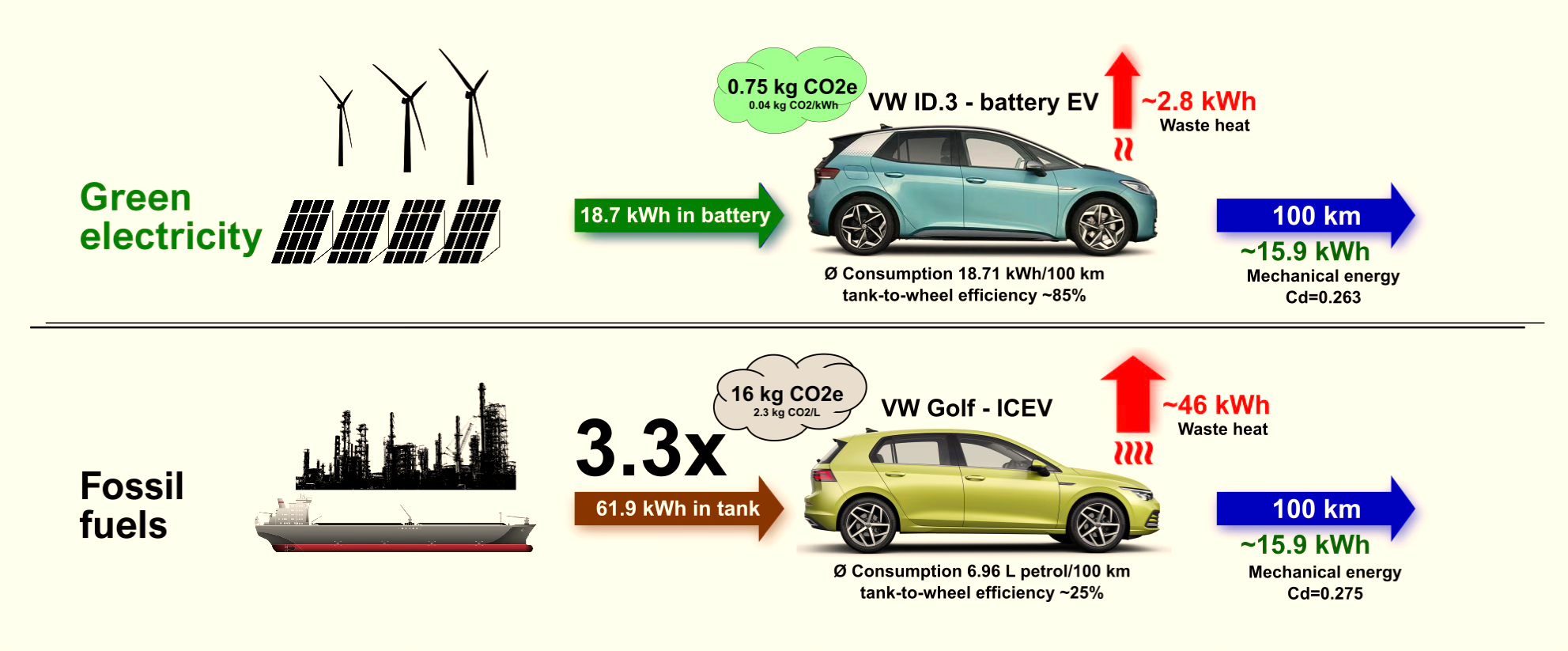
In our comparison, EVs are typically x3-4 times more energy-efficient than ICE vehicles. EVs displace the need for imported gasoline and diesel, shifting transportation fuel needs to domestic electricity sources.
Global Transit Impact
That oil needs to be transported by global shipping - as we have seen, a major geopolitical incident and transit choke-point means ICE vehicles have fragile supply chains.
Switching from ICE to EV offers a secondary benefit to supply chain risk and emissions. The global shipping industry transported approximately 2 billion tonnes of oil in 2023.
The transition to EV can make an enormous impact towards reducing that maritime transport number - you can read more on maritime shipping decarbonisation via the link below.
By charging EVs with local renewable energy, countries and households reduce their exposure to volatile global oil markets and geopolitical risks.
The world is becoming consistently more unstable; the quicker consumers insulate themselves from these shocks, the greater their financial resilience, and the greater the additional climate benefit.
About the Author
Michael Sura

Michael Sura - Energy and transport analyst, strategist, and advisor, based in Slovakia 🇸🇰
 Michael Sura